Replacing Manual Hardware Engineering with an Autonomous AI Fleet
Purpose-built for defense electronics, aerospace R&D, and industrial IoT — from BOM optimization to production-ready PCBA files, in hours, not weeks.
Defense and aerospace engineering groups waste up to 40% of senior engineer time on manual BOM management, datasheet scraping, schematic reviews, and procurement follow-ups — tasks that AI can handle autonomously.
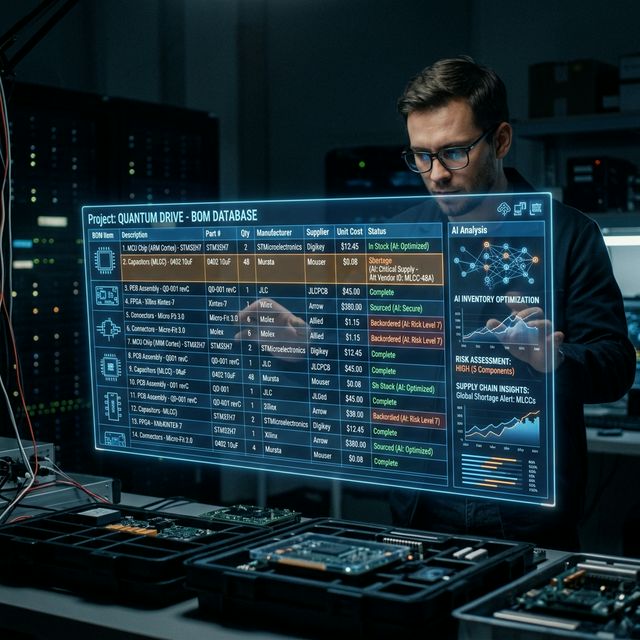
A single BOM rationalization cycle — checking EOL status, finding alternatives, validating derating — takes 2–3 weeks manually. AI does it overnight.
PDN/PCN notices are buried in distributor emails. By the time procurement notices, production lines are already at risk of a critical shortage.
Single-source dependencies and reactive purchasing consistently inflate TCO by 15–30% compared to proactive AI-managed sourcing strategies.
Writing RTL architecture, testbenches, and simulation setups for complex state machines consumes weeks of senior FPGA engineer time per iteration cycle.
DRC violations and thermal design mistakes found during first prototypes cost 10× more to fix than if caught at layout stage. Manual review misses subtle issues.
Reliability issues discovered in the field — wrong derating, impedance mismatches, MTBF miscalculations — cost millions in recalls, rework, and program delays.
Faster BOM Sourcing Cycle
Component Variants Processed
Autonomous AI Agents Deployed
DRC Pass Rate on First Run
NeuralBoard Systems is an AI-native engineering intelligence platform purpose-built for hardware-intensive industries — from defense electronics to industrial IoT. We replace the tedious, error-prone manual workflows that slow your best engineers with an autonomous fleet of specialized AI agents.
Industry leaders like Synopsys and Nvidia have proven that AI can reduce chip design cycles from months to mere hours, while maximizing energy efficiency by up to 67%. NeuralBoard brings these breakthrough methodologies to any R&D team — without the Silicon Valley price tag.
From raw requirements to manufacturing-ready files, our system handles PCBA layout, BOM optimization, FPGA synthesis, procurement, and obsolescence monitoring — all running in parallel, 24/7, on your infrastructure or ours.
Founder, CEO & Chief AI Architect
Senior hardware systems engineer and AI architect with deep expertise in EDA automation, embedded systems, FPGA design, and multi-agent LLM systems. Built and deployed NeuralBoard's entire AI stack — from KiCad Python APIs to LangChain orchestration pipelines — in a production Docker/Kubernetes environment.
💼 Corporate & Enterprise Teams: Looking to embed senior AI hardware expertise into your R&D org? Available for consulting engagements, advisory roles, and fractional CTO arrangements.

A multi-agent autonomous ecosystem taking hardware from raw requirements to manufacturing-ready files — without human bottlenecks.
Translates logical netlists into fully routed .kicad_pcb files while ensuring strict
mechanical and thermal DRC compliance.
Automated BOM rationalization. Prevents EOL risks, identifies alternatives, and guarantees SMC-S-010 derating compliance.
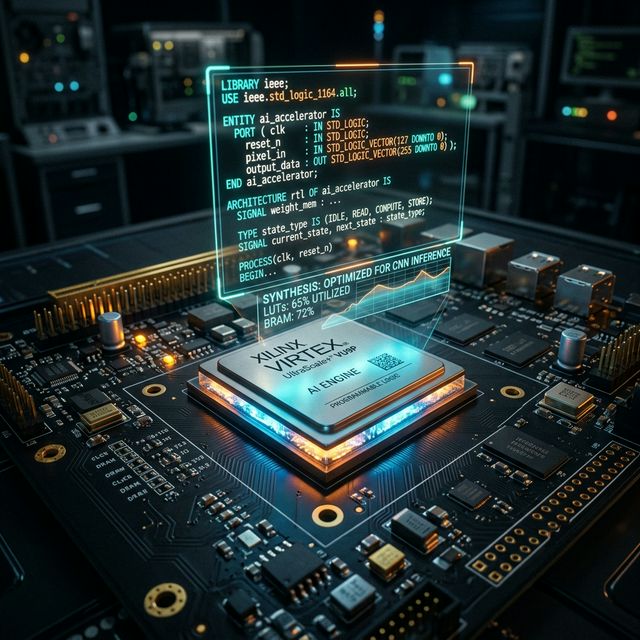
Generates complex RTL architectures and testbenches, instantly validating them against GHDL constraints.
Real-time AI design feedback inside Altium, OrCAD, and Siemens Xpedition. Detects schematic issues and predicts MTBF before sign-off.
Fully independent supplier manager connecting to Digi-Key and Mouser for real-time stock checks and automated TCO optimization.
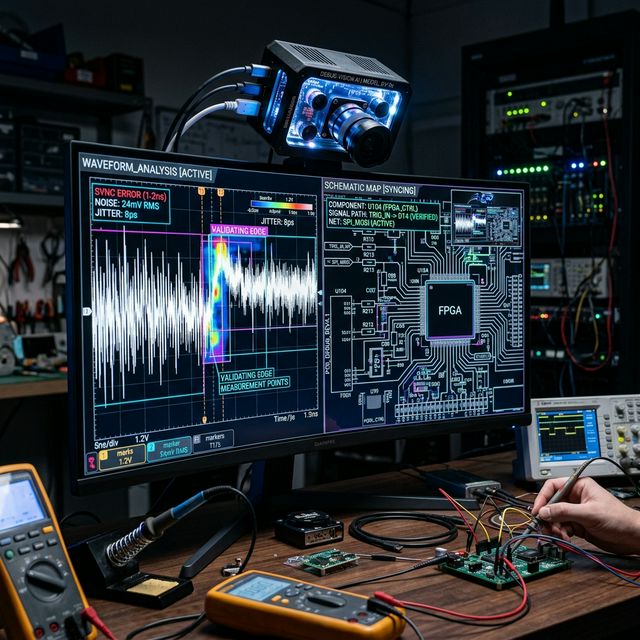
Analyzes oscilloscope waveforms and circuit schematics from images to debug hardware faults in seconds.
Continuous PDN/PCN scanning across global distributors. Alerts before LTB/LTD dates impact your supply chain.
Enterprise integration handling background scanning loops, design request ingestion, and automated reporting pipelines.
From netlist to Gerber in under 4 hours.
Our autonomous Layout Agent leverages direct Python API integrations with professional EDA tools. It handles component placement, impedance-matched routing, and thermal plane generation — strictly adhering to your mechanical constraints. No manual tracing.
Supply chain intelligence at the speed of thought.
The BOM Agent continuously scours Digi-Key, Mouser, and LCSC to identify stock shortages before they impact production. It automatically suggests pin-to-pin alternatives and performs rigorous SMC-S-010 aerospace derating validation.
Production-ready RTL from natural language requirements.
You provide architectural requirements. The agent writes, verifies, and simulates synthesis-ready VHDL or Verilog. Headless GHDL simulations ensure mathematical proof-of-correctness before deployment.
AI co-pilot inside your schematic canvas.
Powered by BQR integration, Synthelyzer lives inside Altium, OrCAD, and Siemens Xpedition. It instantly detects rule violations, pin-mismatches, and current loop errors. Predictive MTBF models ensure your board survives the harshest environments.
Diagnose hardware faults from oscilloscope screenshots.
Feed the Vision AI a messy oscilloscope waveform or hand-drawn schematic. It extracts Vpp, Rise-time, frequency, and anomalies — cross-referencing against the intended design to pinpoint exactly which component is causing the noise.
A fully standalone supply-chain AI application.
Dynamic portal with interactive BOM uploading, live TCO charts, risk assessment, and direct procurement API connectivity. No more manual spreadsheets.
Enterprise integration layer — zero human intervention.
Two massive pipelines running 24/7: the Component Engineer System continuously scans and validates components, and the Design Request API automatically ingests client specs and kicks off engineering pipelines instantly.
Multi-tenant portal with JWT authentication and full audit trails.
All agents are overseen by the Senior Group Hardware Manager Interface. Scoped tenant workspaces, dedicated dashboards for BOM Analysis, PCB DFM, ILS, and Procurement — with full analytics and usage tracking.
How NeuralBoard's Component Engineer agent eliminated hidden supply chain risk and reduced total procurement cost on a mission-critical embedded system.
A defense electronics program faced a quarterly BOM review of 847 components across a 12-layer embedded compute board. The manual process took 3 weeks per cycle, required 2 senior engineers, and still missed a critical PDN notice that nearly halted production.
The BOM Agent processed the full 847-line BOM overnight, identified 23 EOL risks, proposed validated pin-compatible alternatives for all of them, and consolidated the BOM to 612 unique parts — saving ₪280K in procurement costs over the following 6 months.
"The system found a PDN notice our manual process would have missed entirely. That alone justified the engagement cost three times over."— Senior Hardware Program Manager, Defense Electronics Program
A 16-channel high-speed data acquisition controller required a complex state machine with CDC (Clock Domain Crossing) logic. Manual VHDL authoring estimated at 3 weeks. The FPGA Agent produced a verified, GHDL-simulated RTL core with full testbench in 11 hours — including 4 synthesis iterations.
An 8-layer ruggedized compute board (industrial temperature range) was routed by the Layout Agent with impedance-controlled differential pairs and full thermal relief on power planes. The board passed DRC on the first Gerber submission — eliminating a typical 2–3 layout revision cycle that delays tape-out by weeks.
A deployed power supply board exhibited intermittent brownout failures in the field at high ambient temperatures. Engineers sent oscilloscope screenshots and board photos. The Hardware Vision AI identified a capacitor derating violation on the input filter stage within 8 minutes, a diagnosis that had stumped the team for 2 weeks.
From a focused pilot to full R&D integration — structured to deliver ROI at every scale.
Validate the ROI on one focused use case — BOM optimization, PCBA review, or procurement automation.
Ongoing engineering support with full fleet access. Covers BOM, procurement, FPGA, and vision AI continuously.
Full R&D team embedding. Multi-project, multi-team deployment with custom SLA and on-premise Kubernetes setup.
Answers to the questions defense and enterprise teams ask before every engagement.
Yes. NeuralBoard can be deployed entirely on-premise inside your air-gapped network — no data leaves your infrastructure. The full stack runs on Docker and Kubernetes, deployable to any internal server or private cloud. LLM models can be swapped for locally-hosted alternatives (e.g., Ollama-based) where ITAR restrictions apply.
In cloud deployments, only component part numbers and public distributor queries are sent externally. No schematic files, netlist data, or design IP leaves your network unless you explicitly enable cloud ECAD analysis. For sensitive programs, on-premise deployment is the recommended default.
Currently: KiCad (full Python API), Altium Designer (via Synthelyzer® plugin), OrCAD, and Siemens Xpedition. GHDL is used for FPGA simulation. Integrations with Cadence Virtuoso and Zuken CR-8000 are on the roadmap. Custom EDA integrations are available under the Enterprise tier.
Yes. The n8n automation layer provides webhook-based integration with common PLM platforms (Windchill, Teamcenter) and ERP systems (SAP, Priority). REST API connectors can be built for custom internal tools. This is included in the Professional and Enterprise tiers.
Pilot engagements are structured to deliver a measurable output within 4 weeks. Typical timeline: Week 1 — environment setup and data ingestion; Week 2-3 — agent execution and iteration; Week 4 — deliverable report with quantified results. Most clients see positive ROI within the pilot period itself.
Yes. NeuralBoard has been designed from the ground up for defense electronics workflows — including SMC-S-010 derating standards, BQR reliability integration, and air-gapped deployment options. We work with prime contractors and Tier 1 suppliers across defense, aerospace, and intelligence systems.